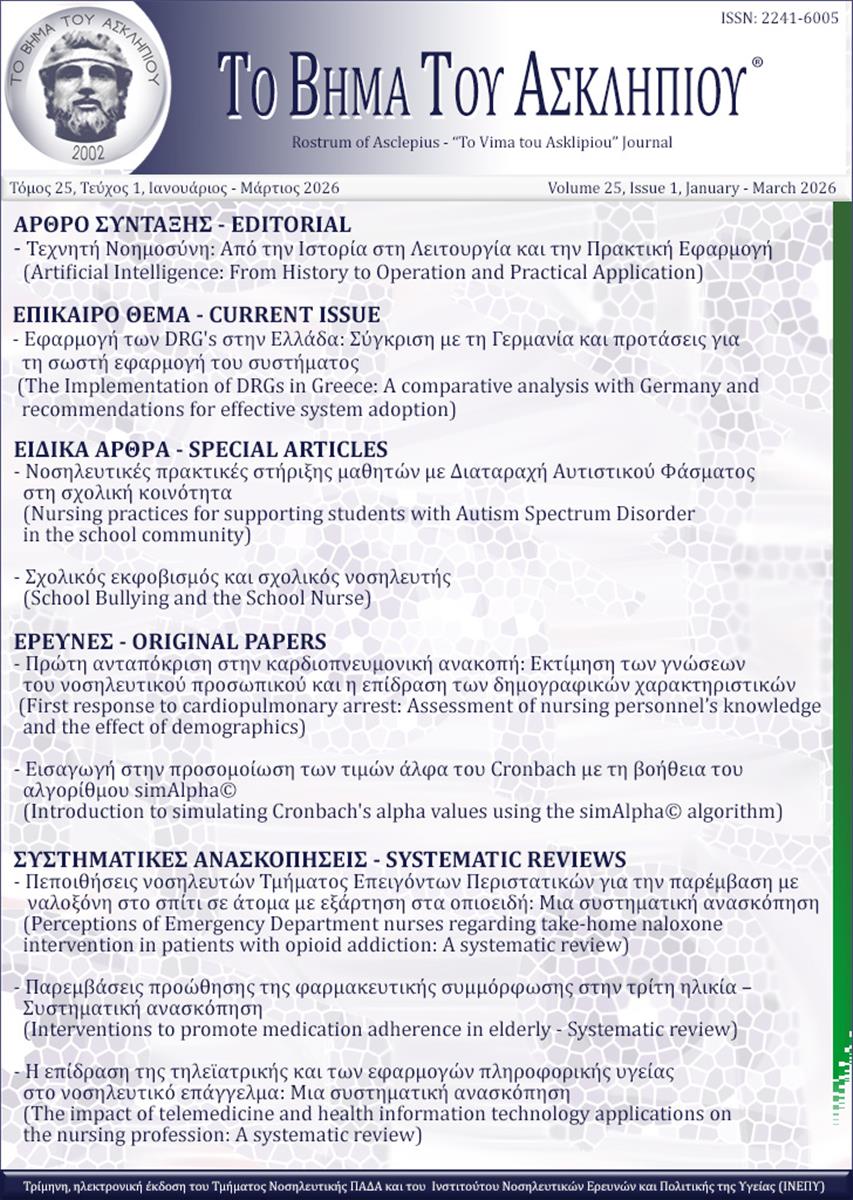
 Rostrum of Asclepius Vol 25, No. 1 (2026): January - March 2026
Introduction: DRGs are used to categorize hospital cases for reimbursement based on diagnosis, procedures, and patient characteristics. Germany, a pioneer in adopting DRGs in 2003, has established a highly efficient system that serves as a model for other countries. In comparison, Greece began applying DRGs in 2012 and continues to face difficulties such as incomplete data recording, lack of specialized personnel, and limited infrastructure. Aim: The aim of this study is to analyze and compare the implementation of DRGs between Greece and Germany, and to propose solutions for a more effective application in the Greek Healthcare System. Method: This study uses a literature review and analysis of the DRG implementation in both Greece and Germany, focusing on technological infrastructure, the categorization process, and continuous education. Results: Key differences between the two countries include advanced technological capabilities in Germany versus manual processes in Greece, a comprehensive classification system in Germany versus a less developed one in Greece, and a strong focus on continuous training for healthcare professionals in Germany compared to Greece's lack of emphasis in this area. To improve the DRG system in Greece, the article recommends upgrading technological infrastructure, implementing targeted staff training programs, refining DRG categories to better align with healthcare needs, and establishing evaluation mechanisms for ongoing assessment. Conclusion: Despite the challenges, the application of DRGs in Greece offers significant benefits. With appropriate investments in technology and staff training, the efficiency of the healthcare system can be improved, leading to better reimbursement outcomes.
Keywords: DRGs, Greek heathcare system, German Healthcare system, hospital reimbursement, healthcare efficiency
Autism Spectrum Disorder (ASD) is a neurodevelopmental condition, with signs often noticeable at a very early age. Individuals on the autism spectrum experience difficulties in social interaction, communication, sensory processing, and more. Early intervention is essential, as the earlier it begins, the more positive outcomes it can yield across various important aspects of a child’s life. The role of the school nurse is crucial in identifying students’ needs, implementing individualized interventions, and ensuring their health and well-being within the school setting. Collaboration with parents and educators, the development of Individual Health Plans, and an in-depth understanding of the unique characteristics of ASD are vital for an effective and holistic approach to care. Students on the spectrum often face significant challenges in personal care and hygiene. Examples include oral hygiene, toileting, and menstruation management for girls. The use of visual aids, social stories, and video modeling contributes to enhancing understanding, self-regulation, and daily functionality in children with ASD. Through such interventions, the school nurse can support students in developing or strengthening self-care skills such as hand washing, bathing, tooth brushing, and more. Visual materials are a powerful tool for teaching skills, often proving more effective than verbal instructions alone. Research has shown that video-based interventions facilitate learning through visual representation and imitation, providing consistent and understandable frameworks for performing daily activities.
Keywords: Autism spectrum disorder, school nurse, interventions
Georgios Raftoulis , Dimitra Koniari
This article is an attempt to investigate the popular issue of school bullying taking into account the multidimensional role of the school nurse. The term “school bullying” undoubtedly includes the use of violence between students or peers to cause some kind of disturbance, even pain. Unfortunately, no student is exempted from this phenomenon. School bullying generally includes the use of verbal, physical, electronic and social violence. The existence of a school nurse can contribute decisively to the prevention and elimination of school bullying phenomena. The thorough investigation of causes and effects as well as the decisive role of the school nurse will be the main axes of the present bibliographic review.
Keywords: School nurse, causes, responsibilities, violence, bullying
George Kipourgos , Angelikh Gkotsi , Konstantina Karanikola , Ioanna Mihou , Christos Marneras , Evangelia Andreopoulou , Anastasios Tzenalis
Introduction: In-hospital cardiac arrest requires an immediate response, a high level of knowledge, and preparedness from all healthcare professionals, regardless of department. Nurses and nursing assistants are typically the first responders, and their effectiveness directly impacts patient survival. As resuscitation protocols are continuously evolving, ongoing education is essential for maintaining clinical competence.
Aim: The aim of the study was to investigate how the demographic characteristics of nursing personnel influenced their knowledge regarding the recognition and initial management of in-hospital cardiac arrest, in order to identify potential knowledge gaps and support the need for targeted educational interventions.
Material and Method: A quantitative, cross-sectional study was conducted with a sample of 87 nurses and 66 nursing assistants from various hospital departments. Data were collected through structured questionnaires evaluating theoretical knowledge, adherence to guidelines, and prior educational experience. Demographic variables—including age, education level, years of clinical experience, and exposure to emergency situations—were analyzed in relation to knowledge levels using appropriate inferential statistical methods.
Results: The findings indicated that demographic factors significantly influenced theoretical knowledge related to the management of in-hospital cardiac arrest. Participants with higher education levels and more frequent exposure to emergency situations demonstrated greater knowledge adequacy. Conversely, knowledge gaps were identified among staff with fewer years of clinical experience and limited participation in resuscitation training programs. These results highlighted disparities in preparedness and emphasized the need for continuous professional development.
Conclusions: The study underscored the importance of ongoing and specialized training in cardiac arrest management. Demographic characteristics were found to influence knowledge levels, highlighting the need for tailored educational interventions. Integrating updated guidelines and research evidence into educational curricula and professional development programs is crucial for enhancing the competence of nursing personnel in critical situations.
Keywords: nurse AND in-hospital cardiac arrest, in-hospital cardiac arrest, Advanced Life Support, demographic factors
A questionnaire is a structured tool used in health research to systematically collect data on perceptions, behaviors, and health outcomes. It serves as a fundamental tool for recording patient-reported outcomes, evaluating treatment effectiveness, and monitoring public health trends. Questionnaires can be administered in a variety of formats, including paper, digital, or interactive systems, and must be carefully designed to ensure reliability, validity, and minimal bias. The simAlpha algorithm was designed in 2023 by Basispap to simulate Cronbach's Alpha and uses R code for its implementation. It has been used professionally in several cases where a simulated study of Cronbach's alpha was needed. In addition, it can provide specific mean values of the Likert scale before the study, as well as the number of participants on demand. It is a useful tool for reducing the time of collecting comparative data e.g. in a pilot study. A brief presentation of the algorithm as well as its strengths and weaknesses is presented. The simulation results show improved behavior for a large number of simulated participants and repetitions (N > 100,000), but the number of simulated questions remains satisfactory even in the case of small numbers, such as e.g. 10 questions. The flexibility of the algorithm needs to be improved for alpha values lower than 0.7. This means that an inexperienced user may have difficulty performing simulations for desired alpha values lower than 0.7, although a more experienced user can easily adjust the desired alpha to obtain the exact required value.
Keywords: Cronbach’s Alpha ; Simulation ; simAlpha
Eleni Alevizopoulou , Evdokia Misouridou , Christina Marvaki , Georgia Toylia
Background: In recent years, there has been an increase in mortality from opioid overdose worldwide. Naloxone is a suitable drug for its treatment. It is a specialized opioid antagonist that acts within minutes and is a safe drug with a low risk of serious adverse effects. The prevention intervention, by distributing a box of inhaled naloxone for home use, to every patient entering the ED with a history of overdose is in line with the WHO guidelines for dealing with the opioid crisis. After receiving a brief training, attendants will be able to administer naloxone in a possible future episode. Aim: The aim of the present study was to investigate the beliefs of nurses regarding the intervention with the administration of naloxone at home.
Material and Method: A mixed method synthesis of studies from a systematic review was performed. Quantitative, qualitative and mixed method studies were retrieved from Google Scholar and PubMed databases. According to the criteria, the studies had to be written in English and published in the last decade. A total of 9 articles were found. Their quality was checked through the Critical Appraisal Skills Program (CASP).
Results: Emergency department nurses positively assessed the adoption of the role of naloxone provider for patients at risk, as well as the responsibility of educating patients and their families. However, obstacles to its implementation were recorded, such as insufficient training, lack of staff, lack of nurses' job descriptions and legal coverage related to the intervention, lack of funding, as well as the reproduction of the social stigma of addiction.
Conclusions: Nurses appear to view their role as a naloxone provider positively. Informed addiction education in all undergraduate nursing programs may contribute to nurses' readiness to respond to the needs of this population.
Keywords: take-home naloxone, perception, attitude, Nurses, emergency department
Panagiota Markou , Dimitra Stachtiari , Asimina Stefou , Sofia Giannakopoulou , Paraskevi Chondronikola , Georgia - Maria Markopoulou
Introduction: Medication adherence is defined as the extent to which a patient is able to follow prescribed instructions regarding the timing, dosage, and administration of pharmaceutical treatments. This includes adherence to guidelines concerning potential adverse effects, drug interactions, appropriate storage conditions, and additional information provided in the accompanying patient information leaflet, which contains critical safety and usage details. Older adults are particularly vulnerable to medication non – adherence, as they frequently present with multiple comorbidities that necessitate complex and often polypharmaceutical treatment regimens. Aim: The purpose of this systematic review was to study the interventions that have been carried out in the last 5 years to promote medication compliance to older adults. The research questions are: “Which are the methods that have been used in interventions in order to promote medication adherence?” and “Which is the effectiveness of the interventions in order to promote medication adherence?” Methods: Articles were searched in PubMed, Scopus and Google Scholar between March 2024 and April 2024 for the years 2018-2024 using the keywords “intervention”, “elderly”, “medication persistence” as well as synonyms. Results: A total of 14 studies were included in the systematic review. The majority of interventions were effective in improving medication adherence in the elderly, enhancing their self-management and increasing their knowledge of rational use of medications. Interventions that included technology and innovative methods such as the use of comics were good strategies for improving the health status of the elderly. However, in order to be effective, interventions must be constantly supervised and continually supported. Conclusion: In conclusion, it is deemed necessary to maintain the implementation of interventions aimed at promoting medication compliance, especially for patient with mental disorders.
Keywords: Medication adherence, Interventions, elderly
Stavros Kormas , Panagiotis Andriopoulos
Background: The quickly development of Information Technology goes with the evolution of Technology, creating an appropriate environment for the effect of Artificial Intelligence (AI). The efficacy of Technology and Information applications affects the development of the economy and industry. The consequence of all above is the emergence of effects in the Health sector and of course consequently also in Health Professionals. Health services rely no longer on information systems programs, which bring only benefit.
Aim: The promotion of the applications of Health Information Technology and Telemedicine in the work of Nurses.
Methodology: A search for scientific articles, published in the English language on the topic of the use of digital health systems and applications for the years 2018-2024, was carried out in the electronic databases Pubmed and Springerlink, using combinations of the following search terms such as: "Telemedicine", "e-Health", "Mobile Health", "Health Professionals", "Professionals Nurses".
Results: According to the findings searched n=81 studies. The majority of e-Health applications work in devices with a daily use such as Smartphone and portable tablets. Remote nursing monitoring can bring a sense of stability in patients and satisfaction of Health Professionals regarding the provision of care. A remote nursing care program, to be accepted by nursing staff and patients, should be characterized by affordability and high protection of personal data.
Conclusions: Hospital centers, in the past created barriers hindering the introduction of telehealth services, while in recent years they have sought to implement strategies for their adoption. It is necessary for a great leap towards digital health, because the implementation of telenursing programs will reduce costs in health systems. Health units tend to implement telemedicine programs locally by using their own resources.
Keywords: Nursing staff, telemedicine, health informatics.

This work is licensed under Creative Commons. Creator Report - Non comercial use 4.0 international.
 Rostrum of Asclepius