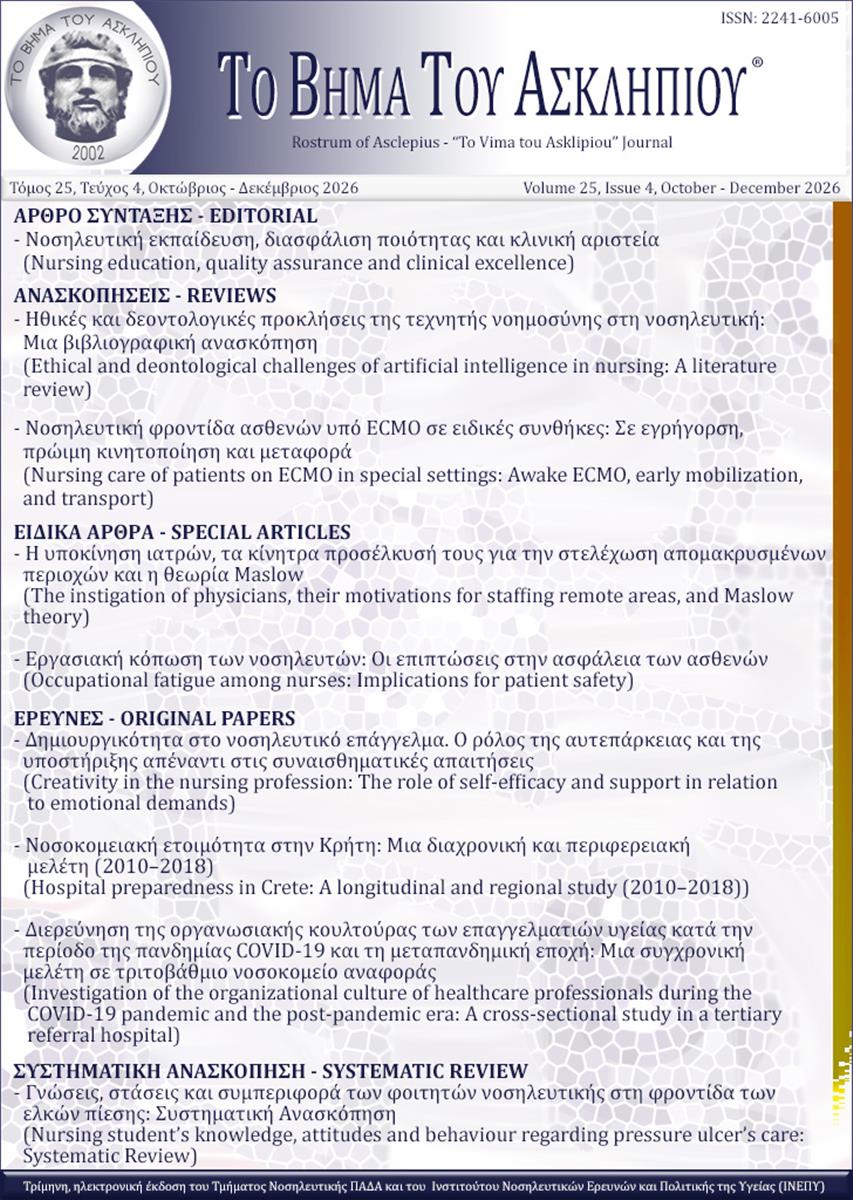
 Rostrum of Asclepius Vol 25, No. 4 (2026): October - December 2026
Nikolaos Darlagiannis , Paraskevi Lountzi , Dimitrios Kosmidis

Background: The rapid integration of Artificial Intelligence (AI) in healthcare has transformed nursing practice, improving efficiency and quality of care, offering new possibilities in decision support. However, the integration of AI in nursing raises important ethical, deontological and legal issues that need to be carefully addressed to ensure its responsible and equitable utilization.
Aim: This literature review explores the ethical issues and challenges arising from the use of AI in nursing and suggests ways to manage these challenges.
Methodology: The literature review search was conducted from 2019 to 2025, in English, in PubMed, Scopus, EMBASE databases. Research studies and reviews with index words: artificial intelligence, clinical ethics, explainability, transparency, bias and combinations of these or their synonyms were included.
Results: Algorithms often function as “black boxes”, which makes it difficult for healthcare professionals to justify their decisions, leading to a lack of trust and difficulty in their acceptance by patients. The allocation of liability in cases of medical errors related to the use of AI remains unclear and may be shared between healthcare professionals, software development companies and healthcare organizations.
Conclusions: The use of AI in nursing requires a balanced approach that combines technological innovation with ethical responsibility. It must be done with care, ensuring that it serves as a tool to support, not replace, nurses. Involving nurses in the development, testing, and training of AI-based systems is not only beneficial but essential. Incorporating nursing knowledge into AI tools ensures that they will be more accurate, effective, ethical, ultimately leading to better outcomes for patients.
Keywords: Artificial intelligence, ethics, explainability, transparency, privacy, bias.
Maria Papadopoulou , Anna Asteriadou , Dimitrios Kosmidis
ABSTRACT
Background: Extracorporeal membrane oxygenation (ECMO) is used in selected patients with severe respiratory or cardiac failure and requires complex, specialized care. Maintaining wakefulness, early mobilization, and transport during ongoing ECMO support create specific clinical, technical, and organizational requirements.
Aim: To investigate nursing care of adult patients receiving ECMO in three specific clinical settings: awake ECMO, early mobilization and ambulation, and transport and interhospital transfer during ongoing extracorporeal support.
Material and Methods: A literature review with descriptive and narrative synthesis was conducted. PubMed, Scopus, and CINAHL were searched for English-language publications from 2016 to 2025. Primary studies, case reports, reviews, and relevant guidelines were examined. Study design, clinical context, and the limitations of each publication were considered during the synthesis.
Results: The synthesis of the literature indicates that awake ECMO can be applied in selected patients, although its effect on clinical outcomes has not been adequately established. Early mobilization and ambulation can also be performed in appropriately selected patients, but their effectiveness and safety remain uncertain. Organized transport during ECMO is feasible, but it is not free of complications. Across all three settings, common requirements include continuous patient assessment, monitoring of the extracorporeal system, early recognition of complications, appropriate training, and interdisciplinary coordination.
Conclusions: Awake ECMO, early mobilization, and transport expand the possibilities of care for selected patients but are associated with increased safety requirements. The nursing role is central to patient assessment, monitoring, and coordination of care. The available evidence does not support considering these practices generally safer or more effective than alternative approaches.
Keywords: Extracorporeal mebrane oxygenation, Critical care nursing, Awake ECMO, early Ambulation, transportation
ABSTRACT The purpose of the current article is to comment on the lack of human resources in the public health sector and the need to incite it. In addition, the categories of incentives that motivate health personnel in Greece and internationally to fill jobs in remote areas are analyzed. Furthermore, the obstacles that create the non-acceptance of jobs in border areas are described. Then, motivational theories are described with an emphasis among motivational theories in Maslow's theory, as the most appropriate for attracting medical staff. Based on this theory, a realistic framework of incentives is presented to motivate doctors in remote areas and proposals are listed to solve understaffing in them. The data were searched in the Greek and international literature, in the scientific search engine Google Scholar, Pubmed and in the database of the World Health Organization. In conclusion, the solution to the difficulties faced by public health organizations in hard-to-reach areas in terms of staffing services with medical staff is the institutionalization of an incentive framework. The desire to achieve universal coverage of workers' needs, satisfaction and efficiency has the ultimate goal of properly staffing distant health structures. Reducing understaffing will improve the quality of health services and the well-being of the population.
Keywords: incitement, motivation, motivation theories, doctors, remote areas
ABSTRACT
Continuous hospital operation requires rotating schedules, night shifts, and often extended working hours for nursing staff, disrupting sleep and circadian rhythms and contributing to occupational fatigue. Fatigue reduces alertness and cognitive performance and is associated with adverse events, particularly in high-risk processes such as medication administration. The aim of the present article was to highlight factors linked to nurse fatigue, examine its impact on patient safety, and summarize evidence-based prevention and mitigation strategies. Evidence indicates that overtime, 12-hour shifts, rapid shift rotation, and inadequate staffing are related to increased sleepiness, reduced performance, and a higher probability of errors. Interruptions during medication preparation and administration further amplify risk by increasing cognitive load and reducing task continuity. Persistent fatigue is also associated with burnout, reduced job satisfaction, and intention to leave the profession. Nurse fatigue is a predictable and modifiable risk factor for patient safety and workforce sustainability. Optimized scheduling, adequate staffing, protected breaks, fatigue risk management, and standardized medication-safety practices may reduce errors and improve quality of care.
Keywords: fatigue, Nurses, Patient safety, medication, errors, shift work
The contemporary work environment in healthcare is characterized by high demands and emotional strain, wich affect both performance and the creativity of nurses. Promoting creativity is considered a crucial factor for the efficiency of healthcare structures and the well-being of nurse staff. The present study aimed to examine the relationship between job demands and specifically emotional demands, self-efficacy, support and creativity in nurses. The sample of the present research consisted of 132 nurses from hospitals, clinics as well as healthcare centers in Northern Greece, who completed questionnaires measuring creativity, self-efficacy, support, and emotional demands. Data analysis included descriptive statistics, correlations, and regression analyses to evaluate the main effects and the interactions. Results indicated that self-efficacy and organizational support were positively related to creativity. On the other hand, emotional demands had a negative effect. Furthermore, the presence of high levels of personal and organizational resources strengthened the relationship between demands and creativity, enabling nurses to effectively cope with work challenges and =generate innovative solutions. In conclusion, promoting creativity in healthcare professionals requires enhancing both personal resources, such as self-efficacy, and organizational resources, such as support from the organization, thereby improving performance and employee well-being.
Keywords: creativity, self-efficacy, social support, emotional demands, Nurses
Vaitsis Koutsipetsidis , Maria Lambraki
Introduction: Operational resilience of healthcare institutions is a critical factor for an effective health system response to mass disasters. This is the first study to longitudinally and regionally assess preparedness in Crete. Aim: To longitudinally and regionally assess the operational preparedness of healthcare personnel in Crete (2010–2018). Material-Method: A descriptive cross-sectional study was conducted using a questionnaire developed by Routsi (2010), which had been used in previous studies in the same hospital. A pilot study (N=20) was conducted prior to the main phase. The sample included healthcare professionals from four phases: EDs of Heraklion (2010, N=83), all staff of Rethymno General Hospital (2012, N=100), Rethymno Operating Room staff (2018, N=32), and a broad regional survey in the 7th Health Region of Crete (2018, N=591). Data were analyzed using SPSS (chi-square tests). Results: In 2012, only 15% had read the preparedness plans. In 2018, 97% of OR staff were unaware of the crisis coordinator and only 9% knew the reference point. Regional analysis showed higher personal preparedness in Western Crete (35.1%) compared to Eastern Crete (27.7%, p=0.009), despite greater equipment inadequacy. Experiential field exercises were preferred by 79.2% of personnel. Conclusions: Despite wide acceptance of the need for crisis plans, practical knowledge of their implementation remains insufficient, creating a «preparedness paradox»: high theoretical acceptance but low operational knowledge. Experiential field exercises are urgently needed. Keywords: Hospital preparedness, mass disasters, crisis management, operational plans, preparedness paradox
Keywords: Hospital preparednes, mass disasters, crisis management, operational plans, preparedness paradox
George Intas , Efthimia Grigoraki , Pantelis Stergianis
Introduction: Organizational culture is an important factor influencing the operation, effectiveness, and quality of healthcare services. The COVID-19 pandemic created unprecedented challenges for healthcare systems, highlighting the role of organizational culture in crisis management and organizational resilience. Aim: The aim of the present study was to investigate the existing and preferred organizational culture of healthcare professionals during the COVID-19 pandemic and the post-pandemic era in a tertiary referral hospital. Material and Methods: A quantitative cross-sectional study was conducted at the General Hospital for Diseases of the Chest of Athens “Sotiria”. A total of 139 healthcare professionals participated in the study. Data were collected using the Organizational Culture Assessment Instrument (OCAI) developed by Cameron and Quinn, which is based on the Competing Values Framework. Statistical analysis was performed using IBM SPSS Statistics software. Results: The dominant organizational culture during the pandemic period was the Hierarchy culture, with a mean score of 33.37±14.48. In contrast, the preferred future organizational culture was the Clan culture, with a mean score of 35.01±13.34. Women reported higher scores in the preferred Adhocracy culture compared with men (p=0.03). Physicians rated the existing Hierarchy culture higher, whereas nurses expressed a greater preference for the Clan culture. Job satisfaction was positively correlated with the existing Clan culture (r=0.41) and negatively correlated with the preferred Market culture (r=-0.33). Conclusions: The COVID-19 pandemic appears to have strengthened hierarchical organizational culture characteristics within healthcare organizations. However, healthcare professionals express the need to transition towards more human-centered and collaborative management models. Strengthening participative leadership, collaboration, and staff support may contribute to improving job satisfaction and the organizational resilience of healthcare services.
Keywords: organizational culture, COVID-19, healthcare professionals, hospitals, job satisfaction, OCAI
EVGENIA VARVIA , Georgios Vasilopoulos , Chrysoula Dafogianni , Georgia Fasoi
ABSTRACT Introduction: Pressure ulcers remain a significant public health concern, with their prevalence ranging internationally from 8.4% to 18.7%. Effective prevention and management require adequate knowledge, appropriate clinical skills, and positive attitudes among nurses. Therefore, undergraduate nursing education plays a crucial role in developing the professional competencies required for the prevention and care of pressure ulcers. Aim: The aim of this systematic review was to investigate nursing students’ knowledge, attitudes, and behaviors regarding pressure ulcer care through a review of the available international literature. Materials and Methods: A systematic literature search was conducted in the electronic databases PubMed, Scopus, and Google Scholar for studies published between 2015 and 2025. The search strategy included the keywords “Pressure Ulcers,” “Nursing Students,” “Knowledge,” “Attitudes,” and “Behaviour,” as well as related terms. Results: A total of 12 studies met the inclusion criteria and were included in this review. The findings indicated that nursing students generally demonstrated an inadequate level of knowledge regarding the prevention and management of pressure ulcers, whereas their attitudes and behaviors toward the care of patients with pressure ulcers were generally positive. Discussion: Overall, the findings of this review indicate that strengthening undergraduate nursing education is essential for improving the quality of nursing care provided to patients with pressure ulcers. Increasing the number of clinical practice hours, incorporating high-fidelity simulation into educational programs, providing systematic instruction on international clinical practice guidelines, and promoting evidence-based nursing practice may substantially enhance nursing students’ knowledge, clinical skills, and critical thinking abilities. Conclusions: The findings of this review highlight the need to strengthen undergraduate nursing education through specialized theoretical and clinical educational interventions aimed at improving nursing students’ knowledge, clinical competencies, and the quality of care provided to patients with pressure ulcers. Keywords: Pressure ulcers; nursing students; knowledge; attitudes; behaviour.
Keywords: Pressure ulcers, nursing students, knowledge, attitudes, behaviour

This work is licensed under Creative Commons. Creator Report - Non comercial use 4.0 international.
 Rostrum of Asclepius