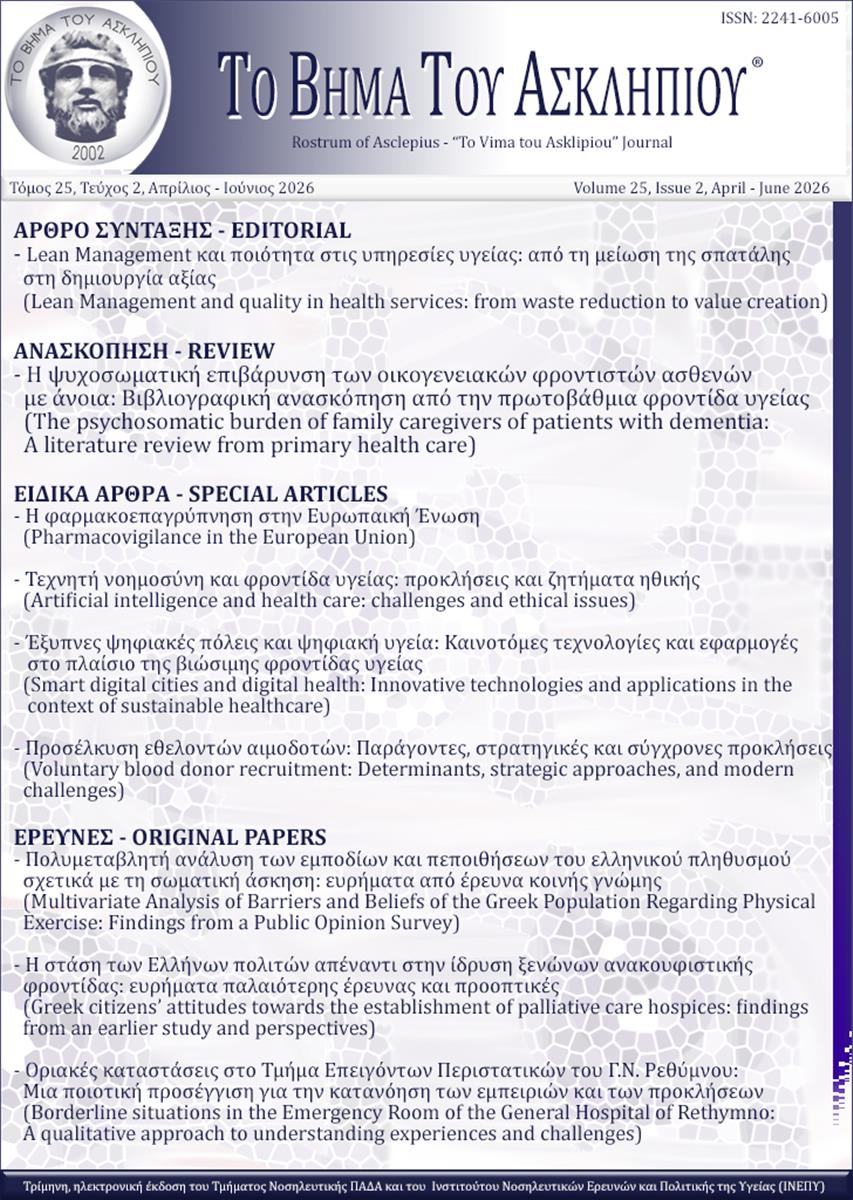
 Rostrum of Asclepius Vol 25, No. 2(2026): April - June 2026
Eleni Tsiara , Ioanna Dimitriadou , Haroula Mesira , Maria Saridi

ABSTRACT
Background: Dementia is a chronic, progressively developing neurodegenerative disease that has a significant impact not only on patients but also on family caregivers who undertake their long-term care. Caregivers are exposed to increased levels of psychological stress and physical strain, with consequences for their overall health and quality of life, making their psychosomatic burden an important public health issue.
Aim: The aim of this literature review is to investigate the psychosomatic burden of family caregivers of people with dementia, as well as to highlight the role of Primary Health Care (PHC) in their identification and support.
Materials and Methods: A review of the international literature was conducted in scientific databases, with an emphasis on studies concerning the psychological and physical burden of family caregivers of patients with dementia, risk factors, and support interventions in the context of PHC.
Results: The findings in the literature show that family caregivers experience increased rates of anxiety, depression, emotional exhaustion, sleep disorders, and physical problems, which worsen as the disease progresses. The lack of education, social support, and respite services intensifies the psychosomatic burden. At the same time, the decisive role of primary health care in the early identification of caregivers' needs and the provision of comprehensive psychosocial support interventions is highlighted.
Conclusions: The psychosocial burden on family caregivers of people with dementia is a serious and often underestimated problem, with significant implications for the sustainability of care. Strengthening primary health care with targeted interventions for the education, support, and relief of caregivers is essential for improving the quality of life of both caregivers and patients.
Keywords: Dementia, Νόσος Alzheimer, family carers, psychosomatic burden, Primary Health Care (PHC), family caregivers
ABSTRACT
The present article aims to examine pharmacovigilance in the European Union (EU) and to identify the regulatory frameworks across its Member States. In the EU, responsibility for pharmacovigilance lies with the European Commission, the European Medicines Agency, and the authorities of each Member State. Effective pharmacovigilance requires close collaboration among EU Member States, the pharmaceutical industry, health and academic institutions, individual health professionals, and patients. Medicines within the EU undergo rigorous testing and evaluation of their quality, efficacy, and safety before approval at either the Member State or EU level. After market authorization, medicines continue to be closely monitored through ongoing pharmacovigilance activities. The legal framework for pharmacovigilance in the EU is established by Regulation No 726/2004 and Directive 2001/83/EC, which were revised respectively in 2010 (Directive 2010/84/EU) and 2012 (Directive 2012/26/EU). Variations in pharmacovigilance regulatory frameworks among Member States are observed in their pharmacovigilance systems, supervisory mechanisms, reporting of adverse drug events by healthcare professionals and patients, and in the traceability of biological medicines. These differences often result in under-reporting of adverse events, primarily due to lack of awareness and training, insufficient collaboration among stakeholders, and the complexity of adverse event reporting processes. Consequently, several challenges must be addressed, including enhanced training for healthcare professionals, adequate financial resources, and improved adverse event reporting systems, ultimately benefiting European citizens.
Keywords: pharmacovigilance, European Union, regulations, drugs, adverse event
ABSTRACT
Artificial Intelligence is a field of computer science focused on developing systems capable of simulating human cognitive functions such as learning, reasoning, and decision-making. It is a key component of the 4th Industrial Revolution, integrating technologies like machine learning, natural language processing, computer vision, and robotics.
Artificial intelligence has evolved from an academic field to a core technology with wide application, transforming critical sectors of modern society such as healthcare, industry, finance, education, and agriculture.
The application of Artificial Intelligence in healthcare is a fast-growing field, leveraging advanced machine and deep learning methods, enabling innovative applications, including diagnostic medical imaging, predictive analytics, personalized medicine, accelerating the discovery of new drugs, and the use of digital assistants.
However, despite the significant benefits, the integration of Artificial Intelligence into clinical practice raises serious ethical, legal, and technical issues. These include the protection of personal data, the need for transparency and explanatory power in algorithmic decisions, addressing data bias, ensuring equitable access, and a clear allocation of responsibility in cases of error. Therefore, its use must be governed by strict ethical standards, transparent operating mechanisms, and a clear regulatory framework that ensures patient rights and safety.
Eleni Patsialou , Ioannis Apostolakis , Pavlos Sarafis
ABSTRACT
Digital transformation constitutes a decisive and strategic factor in the modernization of healthcare services, particularly within the framework of Smart Digital Cities (SDCs), which represent modern, technologically advanced urban structures. Through the utilization of technologies such as Information and Communication Technologies (ICT), the Internet of Things (IoT), wearable devices, and artificial intelligence, innovative solutions are being developed that effectively enhance prevention, diagnosis, early intervention, and health management. The article presents characteristic examples from cities such as Singapore and Thessaloniki, where various digital services are implemented, including remote health monitoring, telemedicine, e-pharmacies, electronic patient records, and “smart” assistive systems for the elderly and people with disabilities. Emphasis is placed on the digital management of chronic diseases, such as diabetes and hypertension, through the use of applications, sensors, and wearable devices that allow continuous and accurate monitoring. The advantages of these technologies are also analyzed – such as improved accessibility, enhanced prevention, cost reduction, and personalized care – as well as the challenges that arise, primarily concerning personal data protection, information security, and the need for technical support. In conclusion, Smart Digital Cities are shaping a new, sustainable, innovative, and human-centered healthcare model, based on continuous collaboration between the state and society. The purpose of this article is to highlight the role of Smart Digital Cities as a decisive factor in the digital transformation of healthcare, presenting applications and practices that contribute to the sustainability and human-centered provision of health services.
Keywords: Smart Digital Cities, Digital Health, Remote monitoring, telemedicine
Konstantina Arseniou , Dimitrios Nasis
ABSTRACT
Voluntary blood donation is a key pillar in ensuring adequate blood supply in modern healthcare systems. The continuous demand for blood and the limited shelf life of blood products make the development of effective donor recruitment strategies imperative. Enhancing voluntary blood donation requires an understanding of the social, psychological, and cultural parameters that influence related behaviors.
The aim of the present article was to explore the factors affecting individuals’ willingness to donate blood, present the main donor recruitment strategies, and evaluate modern technological approaches in both the Greek and international context.
Major motivators for blood donation include social responsibility, personal experience with blood need, and psychological satisfaction from helping others. Conversely, inhibitory factors include fear, lack of information, and distrust in the healthcare system. Strategies such as education, mobile apps, social media campaigns, and the use of artificial intelligence are shown to effectively increase participation, especially among younger individuals.
Strengthening blood donation requires a multifaceted approach, including public education, social recognition, use of digital tools, and cultivation of a culture of volunteerism. The targeted application of such strategies can significantly improve blood sufficiency and enhance public health outcomes.
Keywords: Blood donation, volunteer donors, health communication, social behavior, Mobile health
Demosthenes Panagiotakos , Eleni Evgenia Panagiotakou , Anezina Kataga , Aetos Mavrikis , Denis Machaira , Nikoleta Michailidou , Nikos Dimitriadis , Konstantinos Tambalis
Introduction: Although physical activity is a fundamental health behavior with well-documented benefits in disease prevention and management, it has not been established as a consistent practice among the population. Aim: To explore perceptions, behaviors, and social factors related to physical activity in society, as well as the role of the urban environment. Materials and Methods: A cross-sectional epidemiological study conducted in May 2025 through online surveys and interviews using structured questionnaires. The sample included 1,411 adults from across Greece (mean age 47.5 years, 50.3% women), with 571 permanent residents from small to medium-sized urban areas (cities with fewer than 100,000 inhabitants). Results: A total of 39.3% of women and 47.1% of men reported engaging in sufficient physical activity according to international recommendations (p=0.003). Among residents of small to medium-sized urban areas, 42.9% expressed dissatisfaction with the available public exercise facilities, compared with 32.4% of residents in larger urban areas (p<0.001). Regardless of place of residence, approximately 60% of respondents reported lack of time as the main reason for not exercising, while about 40% cited the lack of suitable and safe spaces. In addition, 40% of participants emphasized the need for more free or low-cost exercise programs. Conclusions: Citizens express a need for free or affordable programs and improved facilities, highlighting the complex barriers to physical activity and the importance of targeted public health interventions.
Keywords:
ABSTRACT
Introduction: The palliative care hospice movement has spread worldwide.
Aim: The purpose of this study was to investigate the knowledge and attitudes of Greek citizens towards the establishment and operation of palliative care hospices.
Material and method: The study was conducted in 2010 on a sample of Greek citizens using a structured questionnaire, which was derived from the processing of a valid and reliable questionnaire (Cronbach’s alpha 0.70). The data analysis was carried out using descriptives
Results: The findings demonstrated a significant lack of knowledge regarding palliative care. However, the majority of participants expressed a positive attitude towards the establishment of hospices in Greece. Obstacles were identified, such as the lack of information, the lack of an institutional framework and the inability of the state to promote such structures.tatistical methods.
Conclusions: Although the study data refer to the period of 2010, they constitute a useful reference point for assessing the progress of the last fifteen years. A comparison with the current situation highlights significant progress, but also ongoing challenges. The need for the development of hostels remains timeless, highlighting the necessity for updated research.
Keywords: palliative care, hospices, citizen attitude, quality of life, Greece
Dimitris Papadopoulos , Panagiotis Kotsonas , Konstantina Taktatzi
ABSTRACT
Introduction: The Emergency Department (ED) is the first point of contact for people in need of urgent medical care. It is open 24 hours a day, seven days a week and is ready to handle medical emergencies such as trauma, cardiac difficulties, respiratory problems and serious infections. The problems that arise in EDs, especially in borderline situations, are a global truth and there have been many relevant studies on this type of situation.
In order to investigate the reality of EDs in borderline situations, an examination was made of the experiences and challenges of the medical and nursing staff in the ED, as well as the strategies they use to cope with the borderline situations that arise. For this reason, qualitative research was carried out through interviews between 28/8/2025 and 3/10/2025. 8 nurses and 2 doctors participated in the research and their selection was made with the help of convenience sampling. A 7-question interview form was used.
The results of the survey showed that overcrowding in Emergency Departments (EDs) is a common problem, with weaknesses in terms of triage due to lack of staff or lack of administrative support. Teamwork is vital for ED workers to manage adversity. Disagreements and conflicts that exist are often due to staff fatigue or confusion due to administrative inadequacy.
As coping measures, workers suggest psychological support and improving the organization and administration of EDs. Also suggested are the improvement of patient reception areas and the redesign of logistics.
Keywords: ICT, Challenges, Experiences, Employees, Qualitative research

This work is licensed under Creative Commons. Creator Report - Non comercial use 4.0 international.
 Rostrum of Asclepius