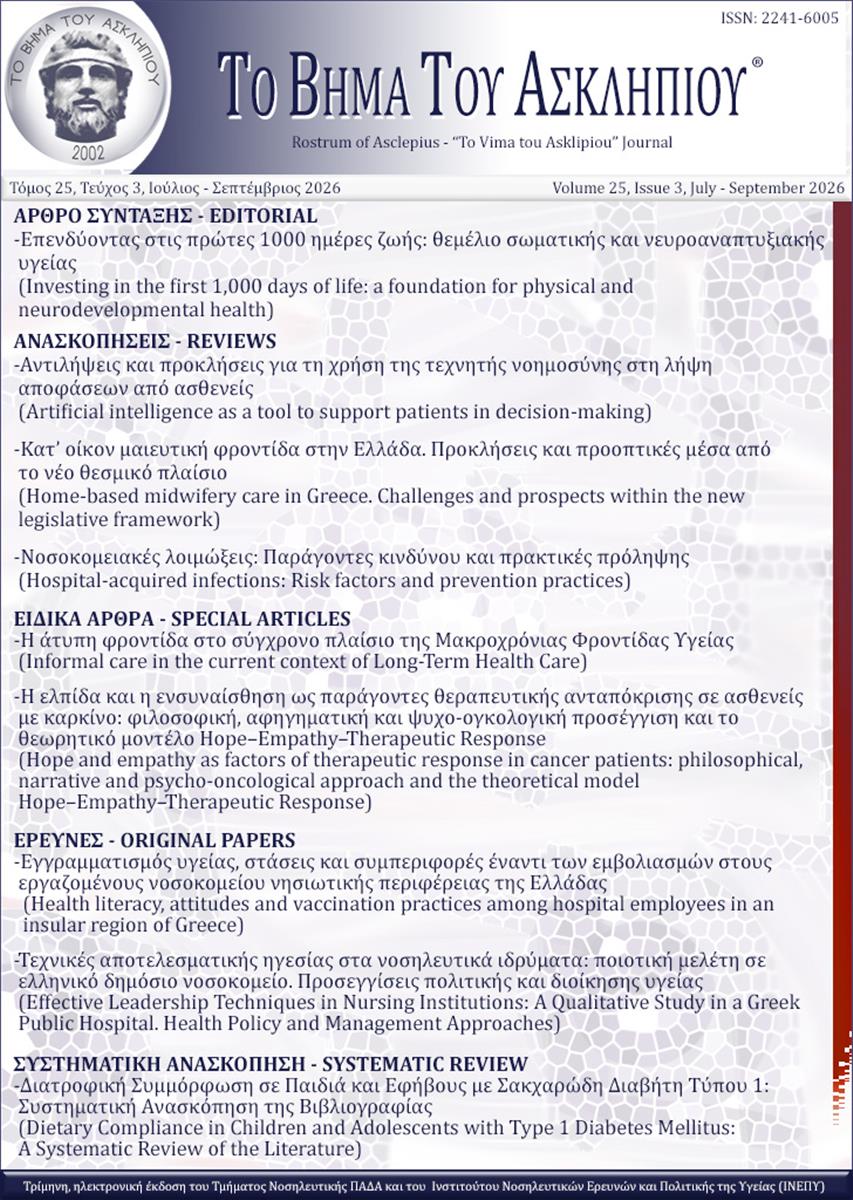
 Rostrum of Asclepius Vol 25, No. 3(2026): July - September 2026
Nikolaos Darlagiannis , Dimitra Armeni , Dimitrios Kosmidis

ABSTRACT
Background: Shared decision-making is a collaborative process between patient and healthcare professional, where both parties actively participate in decision-making. Despite the rapid integration of artificial intelligence in healthcare services, studies focusing on patients’ own views and experiences regarding the role of AI in decision-making remain limited.
Αim: To investigate patients’ attitudes and experiences regarding the use of AI in decision-making, its impact on the therapeutic relationship and the main benefits and challenges that arise.
Material and method: The literature search was conducted from 2019 to 2025, in English, in the PubMed, Scopus, EMBASE databases. Primary research studies and reviews with index words: artificial intelligence, decision-making, patient participation, and combinations of these or their synonyms were included.
Results: Patients appear divided about the adoption of AI in healthcare. Some appreciate its benefits, such as improved diagnosis and treatment, faster data analysis, and enhanced physician capacity, while others express concerns about the lack of human contact, transparency of algorithms, and the risk of bias.
Conclusions: AI should not replace the healthcare professional, but rather complement them, providing better tools for diagnosis and treatment options. This combined approach can lead to safer, more effective, and more personalized care.
Keywords: Patients, decision-making, artificial intelligence, nursing
ABSTRACT
Background: Home-based midwifery care is internationally recognized as a key component of primary midwifery care, providing continuous support to both mother and newborn throughout the perinatal period. Recently, in Greece, an official framework for home-based midwifery care was established for the first time as part of the national health system with the enactment of Law 4999/2022, specifically Article 39 on “Midwives at Home.”
Aim: This article aims to analyze international models of home-based midwifery care and explore their integration into the Greek healthcare system, utilizing the recent legislative framework as an opportunity for reform.
Methods: A narrative literature review was conducted using international databases (Scopus, PubMed, Google Scholar), printed sources, and online reports, with keywords in both Greek and English. The search focused on recent publications from 2020–2025 and sources addressing international models of home-based midwifery care and the Greek legislative framework. Sources were selected based on recency, scientific validity, and thematic relevance. In addition, recent legislative documents related to home-based midwifery care in Greece were examined.
Results: The Greek framework, despite its significant legislative progress, provides general guidance for the provision of services to pregnant and postpartum women and newborns, covering the antenatal and postnatal periods, without clearly defining the organizational components of care. International models highlight the need for developing protocols and explicit guidelines to ensure individualized, continuous, and comprehensive care throughout the perinatal period.
Conclusions: The implementation of international best practices in Greece is feasible, provided that they are adapted into an integrated model of home-based care. Critical factors include establishing continuity of care, strengthening organizational culture, ensuring interoperability, securing adequate funding, and improving accessibility in remote or vulnerable areas.
Keywords: Home-based midwifery care, international care models, legislative framework, continuity of care, primary healthcare
Introduction: Hospital-acquired infections are a major issue that negatively affects the quality of healthcare provided. A nosocomial infection is defined as an infection that was not previously present in the patient's body, either at the incubation stage or in the incubation stage and is acquired during hospitalization. Aim/Purpose: The main purpose of this literature review is to investigate the risk factors surrounding the phenomenon of infections that develop within the hospital environment, as well as to document nursing practices that aim to prevent hospital-acquired infections. Methodology: PubMed, ScienceDirect and Trip Database were used to conduct this literature review. Review and research articles published in English language were selected and the time span was mainly defined as the last fifteen years (2010-2024). The following keywords were searched for: "infection control", "infection prevention", "nosocomial infection", "nursing care quality", "risk factors". Results/Findings: The review of the literature sources revealed numerous factors that pose a risk for the development of infections. These factors are classified into exogenous and endogenous, depending on whether they accompany the patient on admission or are acquired during hospitalization. In addition, various practices that nursing staff can adopt and through which the prevention of nosocomial infections is facilitated were highlighted. These practices are mainly focused on adherence to protocols. Conclusion/Discussion: Hospital-acquired infections pose a major challenge to the healthcare system. However, it has been shown that collaboration among healthcare professionals and the implementation of best practices play a decisive role in both preventing these infections and improving the quality of healthcare services.
Keywords: infection control, infection prevention, Nosocomial infection, nursing care quality, risk factors
Konstantina Botsi , Maria Saridi
ABSTRACT
The article’s objective is to examine the function of informal care services as a component of long-term health care (LTC) in Greece. In this context, the formal LTC services provided in Greece are mapped and studied in their full range, while informal care services are compared with their counterparts in European countries. The proposal further entails the establishment of a refined framework to facilitate informal care, by harmonizing with the practices, incentives and broader health policy of economically advanced European countries.
The results of the study can be summarised in the recognition of the expanded European provision of informal care services as part of LTC. This expansion can be attributed to the broader state planning in some European countries, as well as to the state financial and planning deficits (Greece). The changes that must occur clearly include the connection between informal care and the prevailing care system, as well as its systematic and formal incorporation into the Greek healthcare system, so that society’s requirements and European reform obligations will both be covered.
This will be achieved with a meticulously designed LTC system, which will serve to fortify the provision of informal care through educational, financial, social, and ethical support for informal caregivers.
Keywords: long-term care, informal caregivers, informal caregiving, palliative care, care unit, caregiver needs
Nektarios Alevizopoulos , Eygenia Nikolopoulou
ABSTRACT
A cancer diagnosis constitutes a profound existential experience that affects not only physical health but also the psychological, social, and meaning-related dimensions of human life. Contemporary medicine recognizes that the experience of illness is not limited to its biological dimension but also involves complex psychosocial and existential processes.
The aim of the present article was to explore the concept of hope in the experience of patients with cancer and to analyze the role of empathy in the therapeutic relationship between healthcare professionals and patients. A sub-objective was the proposal of a theoretical model that connects the concepts of hope and empathy with therapeutic response.
This is a theoretical study based on a narrative literature review of the international literature in the fields of psycho-oncology, narrative medicine, and philosophy of medicine. The literature search was conducted in international databases (PubMed, Scopus, Google Scholar) and included publications from the period 2018–2026, as well as classical theoretical works considered fundamental to the study of hope and empathy.
Hope emerges as an important psychological and existential resource for patients with cancer, contributing to psychological resilience and motivating active participation in treatment. The empathy of healthcare professionals strengthens the therapeutic relationship, cultivates trust, and supports the maintenance of hope . Based on the findings of the literature, the theoretical model Hope–Empathy–Therapeutic Response (HETR) is proposed, describing the dynamic relationship between empathy, hope, and therapeutic response.
Conclusions: The integration of humanistic and philosophical approaches into clinical practice may contribute to the development of more patient-centered forms of care and to the improvement of the quality of life of patients with cancer.
Keywords: hope, cancer, empathy, psycho-oncology, narrative medicine
Aikaterini Valsami , Elena Riza , Abraham Pouliakis , George Dounias
ABSTRACT
Introduction: Vaccination is a key public health intervention, contributing both to the promotion of occupational health and safety among healthcare workers and to the improvement of population health overall.
Aim: The aim of this cross-sectional study was to investigate the vaccination coverage, knowledge, attitudes, and practices of employees at a hospital located in an insular region of Greece regarding vaccinations that promote occupational health and safety.
Material and Method: A stratified convenience sampling method was applied to the study population. Data were collected using an anonymous, self-administered, paper-based questionnaire specifically adapted for the purposes of the present study. The study sample consisted of 254 hospital employees (38.84% response rate) representing all healthcare sectors.
Results: According to the self-reported vaccination coverage, 37.4% had been vaccinated for hepatitis A, 70.5% for hepatitis B, 44.1% for MMR, 23.2% for varicella, 55.9% for Tdap/Td, 70.9% for seasonal influenza and 97.2% for Sars-Cov2. Medical professionals showed higher vaccination and knowledge rates than other healthcare workers. The Hospital Infections Control Committee was the main source of information. The majority of respondents (51.6%) believe that hesitancy toward vaccination is due to the possibility of an allergic reaction. Regarding the nature of vaccinations for Healthcare Professionals, the majority believes that they should be optional (42.1%), strongly recommended by 41.3% and mandatory by only 16.5%.
Conclusions: Improving vaccination coverage, health literacy, and attitudes and behaviors of healthcare workers towards vaccines should be a key objective of Public Health policies.
Keywords: health literacy, knowledge, health professionals, vaccination coverage
Margarita Apatsidou , Ioannis Ortoulidis
ABSTRACT
Introduction: Nursing leadership is closely linked to the quality of care, job satisfaction and retention of nurses in the profession, especially in the demanding environment of Greek public hospitals, where understaffing, increased workload and burnout constitute serious challenges. In this context, the investigation of specific leadership techniques applied in daily clinical practice is of particular interest.
Aim: The purpose of the study was to examine which effective leadership techniques are used in the nursing services of a Greek General University Hospital, as experienced by the nurses, the head and the director of the nursing service.
Material and Method: A qualitative, descriptive study was conducted in a General University Hospital of the Greek public health system. Data were collected through semi-structured interviews with 25 members of the nursing staff, selected through purposive sampling, including nurses, a department head and a director of the nursing service. The analysis was carried out using thematic analysis, according to the framework of Braun and Clarke.
Results: Four main themes emerged: clear orientation towards common goals and a shared vision, supportive and consistent presence of the leader in daily clinical practice, open and honest communication combined with high emotional intelligence, and the “hope for success” as a dominant motivation when the leadership style is empowering. At the same time, chronic understaffing, increased workload and non-recognition of physical and mental exhaustion by management emerged as key organizational obstacles to the exercise of effective leadership.
Conclusions: Effective nursing leadership techniques in public hospitals appear to be based on clear goal orientation, strengthening trusting relationships, systematic recognition of effort and high emotional intelligence o nursing staff. At the same time, addressing organizational barriers related to staffing and workload is a necessary condition for implementing empowering leadership in practice and for improving the quality of care and well-being of nurses.
Keywords: nursing leadership, nursing supervisory, quality of health care, Burnout
Anastasia Psichalinou , Eugenia Vlachou , Chrysoula Tsiou , Nikoletta Margari
Managing Type 1 Diabetes (T1D) in children and adolescents is a complex process, with nutrition playing a crucial role in glycemic control and long-term health outcomes. However, adherence to dietary recommendations is often suboptimal, influenced by various individual and environmental factors. This study aims to evaluate the level of adherence to dietary guidelines among school-aged children and adolescents with T1D, and to identify key factors that influence this adherence. A systematic review was conducted following PRISMA guidelines, including primary studies published between 2005 and 2025. Databases such as PubMed and ScienceDirect were searched using predefined inclusion and exclusion criteria. A total of 21 studies involving participants aged 5 to 18 years were included. Findings revealed generally poor dietary adherence among children and adolescents with T1D. Common issues included low intake of fiber, fruits, and vegetables, and high consumption of saturated fats and processed foods. Compliance is influenced by various factors, such as psychological aspects (e.g., food neophobia, eating disorders), family support and dynamics, socioeconomic status and the availability of structured nutritional education. Interventions that incorporated family involvement and behavior-based strategies showed more promising outcomes in improving both dietary adherence and glycemic control. Despite established dietary recommendations, adherence remains low among youth with T1D across various populations. Effective strategies should address not only nutritional education but also psychological, familial, cultural, and structural barriers to promote sustainable dietary behaviors and improve health outcomes.
Keywords: type 1 diabetes, dietary adherence, children, Adolescents, glycemic cotrol

This work is licensed under Creative Commons. Creator Report - Non comercial use 4.0 international.
 Rostrum of Asclepius